
Art has always been a way to tell stories that are often invisible in mainstream narratives. Exploring lesbian art in particular opens a window into intimate moments, hidden desires, and relationships that have historically been overlooked or coded.
Through different images, from the quiet longing in Hawarden’s photographs to the playful, abstracted worlds of Laurencin’s paintings, we can see how artists represent love, connection, and identity across time, using gesture, composition, and color to communicate stories that words often cannot.

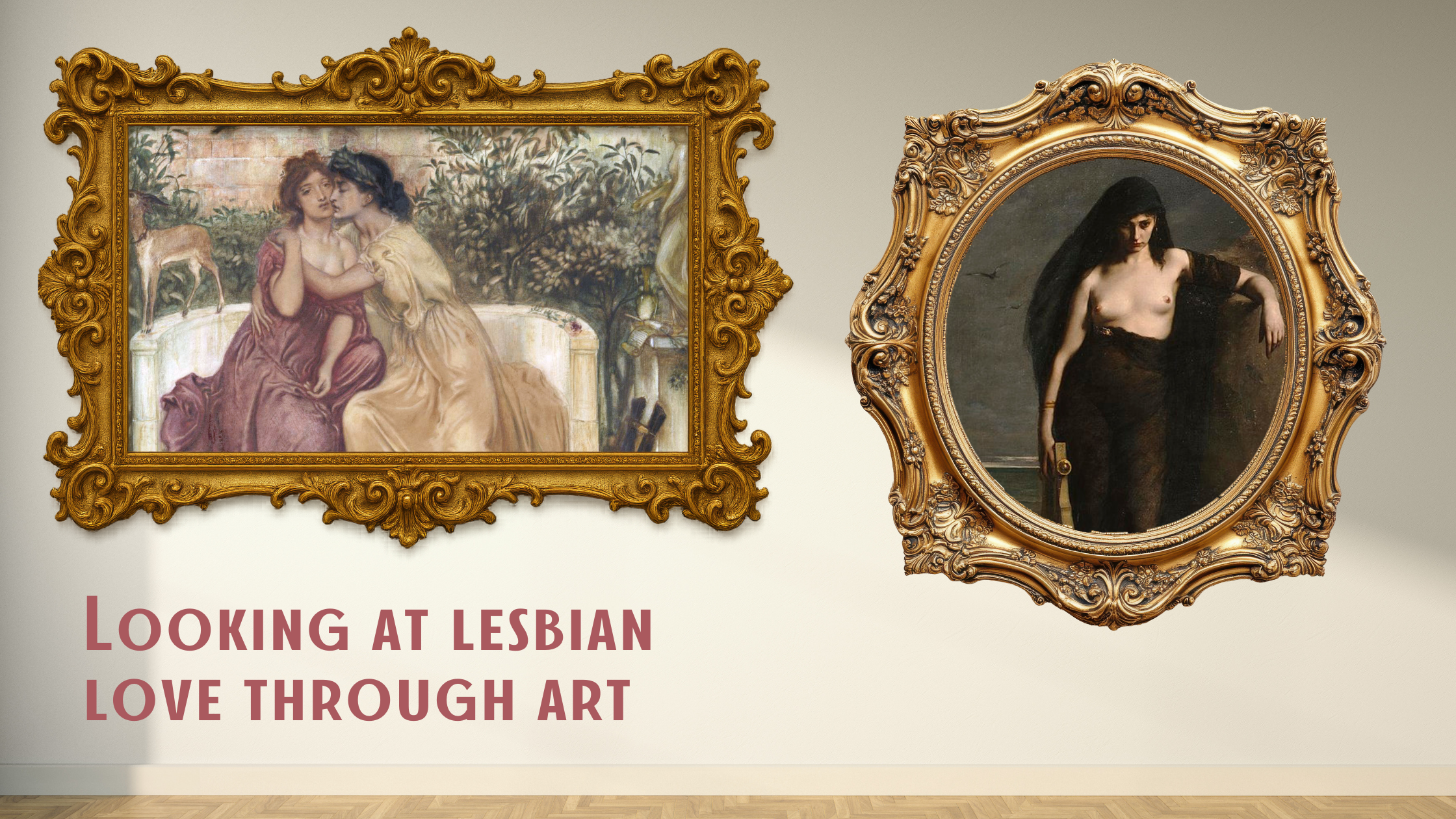
Simeon Solomon’s Sappho and Erinna in a Garden at Mytilene (1864) is a watercolor painting that portrays an intimate moment between two women in a lush garden on the island of Lesbos. In this scene, Sappho (right, in a yellow robe) leans in to embrace Erinna (left, in a pink robe), their faces touching very softly. Erinna’s direct gaze at the viewer invites us into their private world, suggesting a shared secret or a moment of defiance against societal norms. The two doves perched behind them symbolize love and fidelity, while the scattered petals evoke the transient nature of their connection.
The presence of a blackbird may represent external judgment or societal intrusion into their relationship. A small deer beside Erinna, sacred to Artemis and Apollo, may link Sappho to divine inspiration and the Muses. Every detail from the expressions to the positioning of animals contributes to a narrative of lesbian love, desire, and the complexities of intimacy in a world where such relationships were often marginalized.


Sappho by Charles Mengin (1877), shows Sappho as a powerful and lonely figure. Her dark, intense eyes stare off into the distance while her body is painted in lighter tones, making it stand out against the darker background. She stands on a rocky cliff holding a lyre, wearing a thin, almost see-through fabric that clings to her body and exposes her breasts, emphasizing her sensuality.
Her hair and veil flow behind her as if caught in the wind, adding movement and drama to the scene. Her pose isn’t just sad or melancholy, it also feels strong and defiant, like she owns her desire and her emotions. The stormy gray sky and dark sea around her create a moody, dramatic atmosphere, while the sliver of light on the horizon adds a hint of hope.

Weenie Roast Wrestlers, 2019
Jenna Gribbon’s Weenie Roast Wrestlers (2019) is a wild mix of dramatic and silly. Two women are wrestling, half-naked, with their bodies lit in a way that makes every muscle pop, but the scene is playful, not serious. The hot dogs scattered on the ground are obviously a phallic joke, sitting in the dirt and ash, and one of the girls has her foot dangerously close to the hot coals, adding a little tension to the chaos. The lighting makes it feel intense, but the humor keeps it from getting too serious.
Gribbon is playing with sexuality and power here. The wrestlers’ physicality feels intimate and intense, but the absurd props and risky positioning remind us not to take it too seriously. It’s funny, erotic, a little dangerous, and completely rebellious all at once. The piece highlights desire between women in a way that’s playful, confident, and in-your-face

This poster for Love Lies Bleeding immediately grabs attention with its combination of sensuality and danger. The woman in the image is muscular and powerful, showing strength while also drawing the eye with her nearly nude body. Her pose is tense, rising with a gun in her hand, which adds an element of threat and suspense. The lighting is dramatic, highlighting her glistening skin and creating strong shadows that emphasize her form and physicality.
The bright red title and tagline, “Revenge Gets Ripped” reinforce the mix of eroticism and violence, suggesting a story where desire and danger are intertwined. The way she looks off-frame gives a sense that something or someone is coming, heightening the tension. Every detail, from the weapon to her muscular body to the shadows, tells a story of a woman who is both sexual and formidable, flipping traditional ideas of female vulnerability. In the context of lesbian visual storytelling, this image presents queer desire in a way that is aggressive, confident, and unapologetic, using eroticism and power together to create a narrative full of intensity and edge.

Looking at Story of Revenge by Wynnie Mynerva, I’m immediately struck by how it recalls Gentileschi’s Judith Slaying Holofernes while twisting that intensity into something contemporary. The knife plunged into the male figure and the spreading pool of blood mirror Judith’s decisive violence, while a severed breast on a platter above him heightens the ritualized, almost theatrical sense of revenge.
Explosive brushstrokes and contrasts between light, fleshy tones and dark chaos emphasize the women’s strength, sensuality, and control, forcing the viewer to confront both the scene’s brutality and its celebration of female power.

Looking at Clementina Maude and Isabella Grace (ca. 1864), it really feels like a story of pining. The woman in front is so stoic, her face mostly in shadow, looking down with this rigid, almost sad posture. Behind the glass, the other woman reaches toward her, hand hovering just behind her cheek, her face fully lit, eyes wide with longing.
The contrast of light and shadow makes the distance between them feel heavy and emotional, like you can almost feel the ache.

Looking at Marie Laurencin’s The Elegant Ball, the Country Dance (1910), it really feels like a little story about women moving together in their own private world. The figures swirl and overlap in soft pastels, their shapes slightly abstracted and geometric, so it’s less about a realistic dance and more about feeling the rhythm and motion.
You can almost hear the music in the way their bodies curve and tilt. In the background, there are barely-there shapes of trees and grass, soft and airy, making the whole scene feel like an open garden where they can move freely.
In Conclusion
Taken together, these works create a visual lineage of queer storytelling, one that spans centuries yet remains deeply personal. From the soft melancholy of Hawarden’s photographs to the explosive defiance of Mynerva’s canvas, each artist captures a different tone of lesbian experience: tenderness, desire, rebellion, grief, and joy. These aren’t just depictions of women loving women; they’re expressions of agency and identity, of finding beauty and meaning in spaces where visibility was once denied.
Through composition, gesture, and color, these artists communicate what words have often failed to say—that intimacy between women can be sacred, playful, furious, or transcendent. The stories told through their work reject the narrow scripts of how femininity and love “should” look. They give us glimpses of worlds built by and for women, where passion is complex and self-defined.
Exploring lesbian art this way isn’t only about representation; it’s about rediscovery. Seeing how queerness has always existed in art, even when it was hidden in shadows or coded into symbols. These images reclaim that space, transforming invisibility into vision, silence into voice.
Leave a Reply