
Social media marketing has seen a surprising flip in visual storytelling in the last five years. For decades, brands invested heavily in high resolution imagery, controlled lighting, deliberate staging, and studio polish. Influencers, by contrast, built careers on rough edges, handheld cameras, jump cuts, awkward framing, and the emotional immediacy of daily life. The visual divide helped audiences distinguish “content” from “advertising.” That divide is now collapsing. The aesthetic once dismissed as amateur is becoming the template for brand communication. Influencers now polish their content while brands engineer chaos, spontaneity, and rawness. We’ll examine why this reversal is happening, what economic pressures fuel it, how it affects perception, and what designers and media practitioners must understand when producing visual communication in this new environment.
The shift is not simply cultural. It is structural. Influencer marketing has grown into a multibillion-dollar sector, driving brands to adopt visual strategies that feel personal and unfiltered. As audiences grow less responsive to traditional advertising, brands are forced to borrow the language of creators in order to retain cultural relevance. Influencers, meanwhile, pursue higher production value in an attempt to elevate status, distinguish their personal brand, and attract higher-budget partnerships. In effect, the two groups have swapped aesthetic positions. The result is a media environment where authenticity is manufactured, intimacy is curated, and relatability is a commercial strategy.
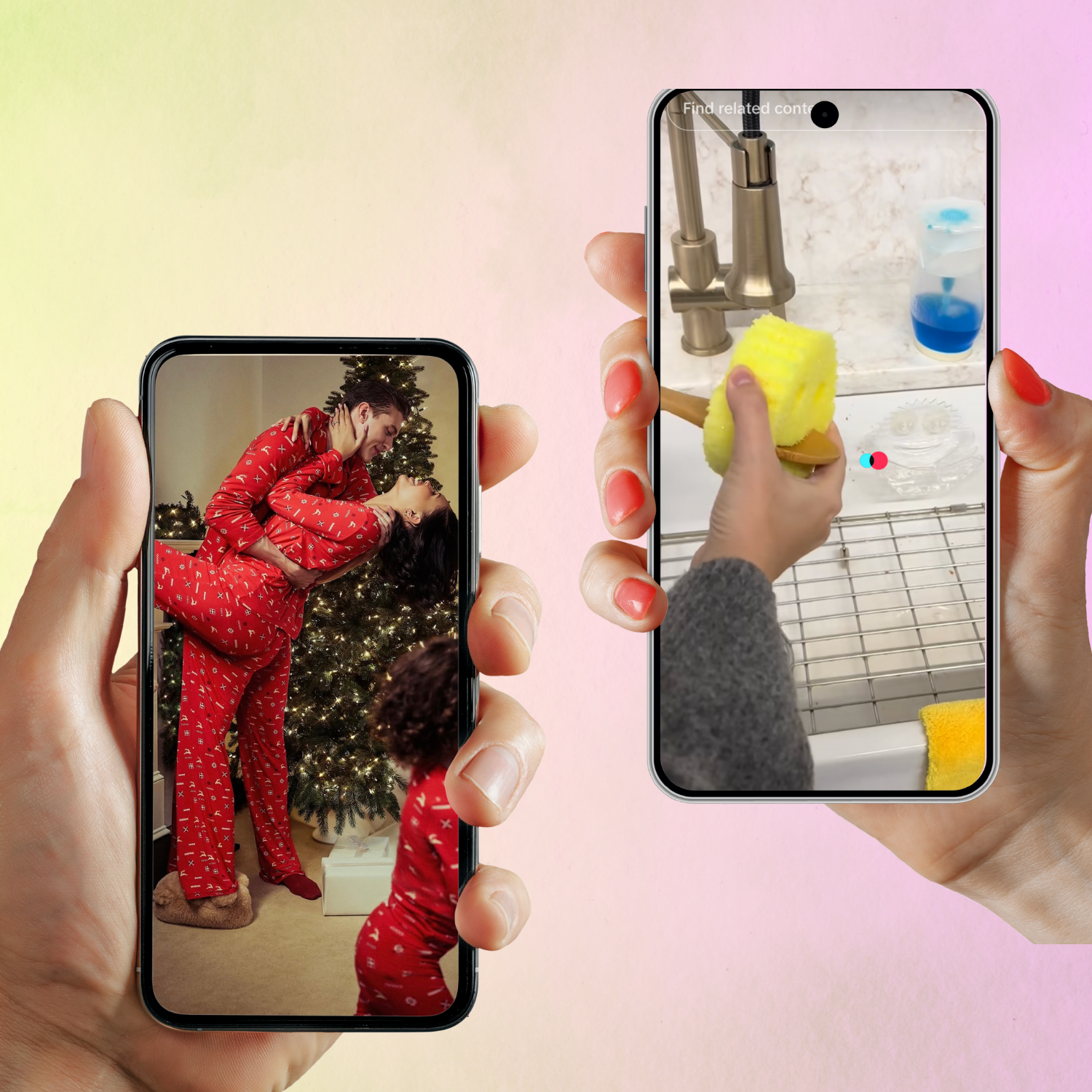
Duolingo and Influencer, Nara Smith, have two very different looks to their social media platforms.
The Influencer Has Replaced the Advertising Studio
Influencer marketing is no longer a fringe tactic or a supplemental expense. It now occupies a central position within global marketing budgets, reshaping creative strategies and the visual expectations of audiences. The appeal is clear. Influencers deliver emotional intimacy, storytelling fluency, and platform-native communication styles that older advertising structures cannot easily replicate. Their power is not simply reach but resonance: they speak to audiences in a way that feels unmediated, conversational, and grounded in personal experience (Cotter, 2019).
The rise in influencer budgets has produced an unexpected consequence. If the most emotionally effective content comes from individuals rather than corporations, brands must now imitate individuals to remain competitive. This has led to a sophisticated emulation of influencer aesthetics, as corporations adopt handheld cameras, domestic backdrops, direct-to-camera confessionals, and humor-driven sketches. The shift reflects not only a stylistic change but an economic one. Influencer marketing’s expansion has pressured brands to adopt the same emotional markers that drive creator success (Lopez, Chefor, & Babin, 2023; Zhang, X., & Choi, J., 2022). The visual language that once belonged to personal storytelling has become the lingua franca of marketing.
This is particularly evident in brand behavior on TikTok, where accounts for companies like Duolingo, Ryanair, Scrub Daddy, and The Washington Post engage in character-driven sketches that mirror influencer trends. These brand accounts communicate not as institutions but as personalities. The corporate identity dissolves behind a mascot or employee, whose face and voice serve as the actual brand interface. The result is a new advertising environment in which the corporate “we” is replaced by the apparent intimacy of “me,” even when the “me” is a carefully constructed performance supported by strategists, writers, designers, and legal teams (Eldesouky, 2020).
An especially illustrative example comes from Lionsgate, which has started hiring TikTok fan editors to produce content for its studio account. Traditionally, entertainment companies fought against fan edits due to copyright, yet Lionsgate flipped the script by incorporating these creators into their content strategy. Scrolling through Lionsgate’s TikTok account, viewers are likely to assume they are encountering an independent editor rather than corporate messaging, just take a look at the comment sections (Shanfeld, 2025). This strategy capitalizes on audience expectations of authenticity while blurring the line between personal and corporate content.
Lionsgate’s feed is now full of fan-style Tiktok edits of their most popular IPs. Fans even comment on how they’re shocked to see these are Lionsgate’s posts.
Emotional Design Becomes the Currency of Authenticity
Emotional design theory helps explain why influencer aesthetics have overtaken traditional brand storytelling. Don Norman’s framework of visceral, behavioral, and reflective responses provides a useful lens for understanding the psychological mechanisms behind this shift (Norman, 2004). Influencer content succeeds because it engages all three emotional levels simultaneously. At the visceral level, influencer visuals feel immediate and personal. Viewers internalize the handheld camera, natural lighting, and unpolished presence as signals of honesty. These aesthetics activate a sense of shared everyday experience that advertisers once struggled to achieve (Zhang, X., & Choi, J. 2022; Lopez, Chefor, & Babin, 2023).
Behavioral design is equally critical. Influencer-style content is short, intuitive to follow, and structured around the rhythms of platform use. The editing patterns: fast cuts, captioned voiceover, micro-stories, fit the attention demands of social media. Brands mimic these structures because they match the cognitive habits of contemporary audiences (Manic, 2024). A thirty-second polished commercial feels intrusive; a casual, vertical, jump-cut montage feels native.
Reflective design, which concerns meaning-making and identity, is perhaps the deepest influence. Influencers communicate personal narratives that allow viewers to form parasocial bonds. Even when viewers understand that influencers are selling products, the emotional connection remains intact. Brands, witnessing this dynamic, increasingly embed values, identity cues, and lifestyle narratives into their visual storytelling (Mzizi,2025; Khamis, Ang, & Welling, 2016). They position products not as isolated commodities but as elements within a curated emotional life. This trend aligns with color psychology, persona development, and mood-driven design theories, which have now become central to influencer culture because emotional resonance is the primary currency of online visibility (Norman, 2004; Zhang, X., & Choi, J. 2022).
In short, emotional design has become an egalitarian toolkit. Both influencers and corporations now deploy it in ways that blur their identities, further collapsing the line between personal expression and commercial messaging (Lopez, Chefor, & Babin, 2023).
Dunsen Dunsen, featured in a recent New York Times piece, has a whole ‘home’ studio located in their office in Brooklyn, NY to create influencer like content.
The Rise of Emotional Authenticity as Strategy
This reversal is tied to a larger shift toward emotional rather than informational persuasion. Traditional advertising foregrounded product benefits, technical specifications, and controlled brand voice. Creator-driven content foregrounds emotional resonance. Affection, humor, embarrassment, sincerity, and vulnerability have become central mechanisms for capturing attention (Pine & Gilmore, 1998, Cotter, 2019). Designers and visual storytellers increasingly craft content that places the viewer inside the emotional life of the subject rather than simply displaying the product.
Influencer aesthetics gained traction because they invited viewers into a social relationship. The camera became an extension of the creator’s presence. Media researchers describe this as parasocial intimacy. When brands adopt creator aesthetics, they attempt to replicate that intimacy. They seek to produce the illusion of direct address, candid revelation, and spontaneous storytelling. The emphasis is not on presenting a perfect image but on delivering an emotional experience that feels lived rather than staged (Norman, 2004; Zhang, X., & Choi, J. 2022; Lopez, Chefor, & Babin, 2023).
However, when brands engineer authenticity, they introduce contradictions. If authenticity is crafted, it ceases to be spontaneous. If relatability is a strategy, its honesty becomes conditional. Audiences increasingly express skepticism toward polished influencer content and toward brand content that attempts to disguise its persuasive intent. The result is a “performance of authenticity,” recognizable yet difficult to resist (Ali, 2025; Vuković & Pavković, 2025).
Influencers Jaclyn Hill and Mikayla Nogueira, who rose from humble beginnings to social media stardom, have recently faced backlash from viewers calling them ‘out of touch’. Just take a look at their comment sections.
The Economic Logic Driving the Reversal
Influencer marketing has become a significant part of modern advertising budgets. Industry analyses consistently place global influencer-marketing spending above $30 billion in 2025 (Influencer Marketing Hub, 2024). This expansion reflects more than trend adoption. It illustrates a fundamental shift in how brands allocate resources. Instead of relying solely on traditional campaigns, companies devote substantial funds to creator-driven partnerships and to rapid content cycles that match platform expectations (Eldesouky, 2020).
This economic landscape produces incentives for brands to create their own influencer-style content internally. When brands hire independent influencers, those creators must label their posts as sponsored under advertising regulations. These disclosures often reduce engagement since audiences may scroll past content that explicitly signals paid promotion. If a brand produces influencer-style content through its own channels, it does not need sponsorship labels because it is not external paid placement, creating a loophole where branded advertisements take on the appearance of organic posts.
The second economic force driving the reversal is production efficiency. Creator-style content is inexpensive to produce. It demands speed rather than polish. Brands under pressure to maintain constant visibility can generate dozens of low-fi videos in the time it once took to plan a single thirty-second commercial. The low-pressure aesthetic lowers barriers for experimentation, iteration, and audience testing (Zen, 2025; Thomas, 2025).
The third force is aspirational inversion. Influencers, now competing for brand partnerships, attempt to convey higher value by elevating their production quality. Their content shifts from candid to cinematic. This reinforces the reversal: brands imitate rawness to appear human, while influencers imitate brands to appear professional (Manic, 2024).
Scrub Daddy opts for chaotic, low budget style ads that mimic social media trends and memes. Imagine explaining the “Funeral Stud Singer” to your managers…
Audience Perception and the Question of Trust
As influencer and brand visual strategies converge, traditional trust cues tied to studio lighting, polished scripts, and clear commercial framing become unstable. With brands adopting influencer aesthetics, audiences face ambiguity in distinguishing between genuinely personal content and persuasive messaging, a dynamic that can increase both engagement and skepticism among consumers (Ali, 2025; Vuković & Pavković, 2025). Research on social media advertising shows that perceived authenticity and credibility are key drivers of trust in digital content, and when these signals are weak or obscured, consumer confidence in a message declines (Kothari et al., 2025).
Audiences do not inherently prefer raw authenticity, but rather the performance of authenticity that aligns with expectations of sincerity and relatability. Studies of social media advertising and influencer behavior find that when content feels “untouched” or “real,” even if imperfect, consumers engage more readily because they perceive the endorsement as trustworthy. Yet this tolerance for imperfection depends on audiences interpreting it as genuine rather than contrived, meaning that brands attempting to simulate authenticity can risk backlash or increased skepticism when the artifice becomes visible (Chavda & Chauhan, 2024; Vuković & Pavković, 2025).
Influencers themselves confront a similar tension. As creators increase their production values, audiences sometimes perceive them as “selling out,” noting that higher polish can erode the sense of personal connection that forged early parasocial bonds. Research on influencer trust and audience perception highlights how follower trust is mediated by perceived authenticity, such that credibility, transparency, and genuine alignment with audience values are essential for maintaining trust even in commercial contexts (Ali, 2025; Vuković & Pavković, 2025). When influencers’ commercial motives are too salient, audiences may see the influencer as a performer rather than a peer, weakening the very trust that underpins their persuasive impact (Kothari et al., 2025).
This convergence of influencer and brand strategies also raises ethical concerns, particularly around transparency and consumer awareness. Academic analyses emphasize that clear disclosures of sponsorships and paid partnerships are critical for maintaining consumer trust in digital environments; without them, persuasion risks becoming deceptive because audiences can no longer easily identify when content serves commercial interests (Vuković & Pavković, 2025; Chavda & Chauhan, 2024).
Vanillamace is a rising creator whose popularity has skyrocketed on TikTok this year, thanks to her captivating blindbox openings and refreshingly authentic persona. Many online now recognize her as one of the ‘realest’ content creators around.
When People Look Like Brands: Influencers Become Corporations
The convergence does not move in only one direction. Influencers increasingly adopt branding strategies once exclusive to professional marketing departments. Research shows that successful creators now develop consistent color palettes, typography choices, and visual signatures that reinforce recognizability across platforms—practices that closely mirror traditional brand identity systems (Khamis, Ang, & Welling, 2016; Chavda & Chauhan, 2024). Many influencers produce media kits, mood boards, and style guides, and they hire editors, strategists, and production assistants, creating operational structures that resemble boutique creative agencies rather than individual creators.
This transformation reflects the pressures of platform economies. Influencers who want to grow must maintain visual consistency, because platform algorithms tend to privilege recognizable patterns and reliably branded aesthetics (Kothari et al., 2025). As a result, creators refine their aesthetic identity until it becomes as systematic and codified as any corporate brand. Studies on digital branding note that personal brands increasingly rely on color systems, symbols, and narrative cues that are as semiotically deliberate as global corporate identity systems (Khamis, Ang, & Welling, 2016).
Influencers rely on these tools to create structure, not because they were formally trained in design, but because the market demands coherence and recognizability (Chavda & Chauhan, 2024, Cotter, 2019). A viewer who recognizes the color palette of Emma Chamberlain’s Instagram posts or the editing rhythm of a MrBeast video understands the brand as intuitively as they might recognize the visual system of Coca-Cola or Apple. Influencers use emotional storytelling to create intimacy while using visual branding to build reliability, whereas corporations use visual branding to maintain coherence while relying on emotional storytelling to appear personable. These ambitions intersect, making their outputs increasingly alike (Khamis, Ang, & Welling, 2016; Kothari et al., 2025).
MrBeast’s videos have sparked a YouTube renaissance, inspiring creators to chase similar success. Charli D’Amelio, who first rose to fame with TikTok dances, has now expanded her brand into a professional career, even appearing on Broadway.
Ethical, Cultural, and Creative Stakes
As brands and influencers continue to mimic one another, the most pressing question becomes not who started it but who benefits. The collapse produces cultural ambiguities that complicate trust. Influencers risk being perceived as overly corporate, losing the authenticity that once defined their appeal (Ali, 2025; Vuković & Pavković, 2025). Brands risk crossing ethical boundaries by producing content that intentionally conceals its persuasive nature, a concern well-documented in research on transparency and digital advertising ethics (Vuković & Pavković, 2025; Chavda & Chauhan, 2024). Audiences face increasing difficulty discerning what is genuinely expressive from what is strategically crafted, especially as emotional signals become standardized markers of persuasion (Kothari et al., 2025).
The convergence also has creative implications. If all content begins to look the same, visual storytelling risks stagnation. Scholars of digital branding warn that homogenization diminishes creative distinction and contributes to a marketplace where strategic conformity overshadows originality (Khamis, Ang, & Welling, 2016, & Abidin, 2025). This outcome contradicts the emotional principles that made influencer storytelling compelling in the first place. Authenticity loses meaning when the symbols associated with it are mass-produced, reducing emotional design to a formula rather than a genuine relational strategy (Norman, 2004; Zhang, X., & Choi, J., 2022).
Innovation will likely emerge from creators or brands willing to break away from established influencer tropes, a position aligned with contemporary arguments for design differentiation in saturated media ecosystems (Lopez, Chefor, & Babin, 2023). Emotional storytelling, applied ethically, can restore sincerity by prioritizing transparency instead of disguising it. The future of visual communication demands a renewed commitment to clarity, even within aesthetic systems designed to feel casual and approachable.
Clubbing and party influencer @bran__flakes pulls back the curtain on partnered brand ads on TikTok. The conversation heats up online as creators like @yuvaltheterrible question the ethics of undisclosed or “discreet” promotions.
Conclusion
As the fight for attention online continues, influencers and brands increasingly duke it out for attention. What once seemed opposite, creator spontaneity versus polished advertising, now operates within the same emotional marketplace, where visibility depends on resonance rather than production pedigree. Persuasive power has shifted from distance and polish to closeness and relatability, collapsing the line between commercial messaging and personal expression (Chavda & Chauhan, 2024; Vuković & Pavković, 2025).
For designers and marketers, technical polish no longer guarantees professionalism, nor does imperfection signal authenticity. Understanding emotional cues, platform-native aesthetics, and audience expectations is essential. The tools of color psychology, persona development, mood-driven design, and emotional design theory now shape how audiences interpret sincerity and assign trust.
The era of clear boundaries between advertising and personal content has ended. Authenticity is tactical, intimacy is engineered, and emotional resonance drives attention. Designers must create ethically transparent, emotionally sophisticated, and contextually aware work, the new foundation of credible media in a hybridized, influencer-driven landscape.
Sources
Abidin, C. (2016). Visibility labour: Engaging with influencers’ fashion brands and Instagram advertorial campaigns. Media International Australia, 161(1), 86–100. https://journals.sagepub.com/doi/10.1177/1329878X16665177
Ali, H. L., Kasirye, F., & Ha, L. (2025). Does Follower Size Matter? Diversity of Sources and Credibility Assessment Among Social Media Influencers. Information, 16(11), 958. https://doi.org/10.3390/info16110958
Audrezet, A., de Kerviler, G., & Moulard, J. G. (2020). Authenticity under threat: When social media influencers must go beyond self-presentation. Journal of Business Research, 117, 557–569. https://doi.org/10.1016/j.jbusres.2018.07.008
Chavda, K., & Chauhan, R. (2024). Influencer marketing impact on consumer behavior: Trust, authenticity, and brand engagement in social media. Journal of Advances in Accounting, Economics, and Management, 1(3), 1–9. https://doi.org/10.47134/aaem.v1i3.180
Cotter, K. (2019). Playing the visibility game: How digital influencers and algorithms negotiate influence on Instagram. New Media & Society, 21(4), 895–913. https://doi.org/10.1177/1461444818815684
Eldesouky, Doaa. (2020). Visual Storytelling in Advertising: A Study of Visual Storytelling as a Marketing Approach for Creating Effective Ads. International Journal of Humanities, Social Sciences and Education. 7. 118-127. 10.20431/2349-0381.0710015.
Gretzel, U. (2016). The visual turn in social media marketing. Tourismos, 12(Special Issue), 1–17. https://doi.org/10.13187/tourismos.2016.12.1
Influencer Marketing Hub. (2024). Influencer marketing benchmark report. https://influencermarketinghub.com/ebooks/Influencer_Marketing_Benchmark_Report_2024.pdf
Khamis, S., Ang, L., & Welling, R. (2016). Self-branding, ‘micro-celebrity’ and the rise of social media influencers. Celebrity Studies, 8(2), 1–18. https://doi.org/10.1080/19392397.2016.1218292
Kothari, H., Choudhary, A., Jain, A., Singh, S., Prasad, K. D. V., & Vani, U. K. (2025). Impact of social media advertising on consumer behavior: Role of credibility, perceived authenticity, and sustainability. Frontiers in Communication, 10, Article 1595796. https://doi.org/10.3389/fcomm.2025.1595796
Lopez, C., Chefor, E., & Babin, B. J. (2023). Rethinking authenticity: An investigation of virtual influencers: An abstract. In B. Jochims & J. Allen (Eds.), Optimistic marketing in challenging times: Serving ever-shifting customer needs. AMSAC 2022. Developments in Marketing Science: Proceedings of the Academy of Marketing Science. Springer, Cham. https://doi.org/10.1007/978-3-031-24687-6_36
Lupton, E. (2017). Design is storytelling. Cooper Hewitt, Smithsonian Design Museum. (Course Book)
Manic, M. (2024). Short-form video content and consumer engagement in digital landscapes. Bulletin of the Transilvania University of Brasov. Series V: Economic Sciences, 17(66), 45–52. https://doi.org/10.31926/but.es.2024.17.66.1.4
Mzizi, Y. (2025). Influencing Without the Influencers. The New York Times. https://www.nytimes.com/2025/07/06/style/brand-content-marketing-videos-influencers.html
Norman, D. (2004). Emotional design: Why we love (or hate) everyday things. Basic Books.
Norman, D., & Ortony, A. (2016). Designers and users: Two perspectives on emotions and design. Design Issues, 32(1), 3–14. (Module 3)
Pine, B. J., & Gilmore, J. H. (1999). The experience economy. Harvard Business Review Press. (Module 3)
Shanfeld, E. (2025, October 17). Lionsgate uses TikTok fan edits to market movies. Variety. https://variety.com/2025/film/news/lionsgate-tiktok-fan-edits-1236551825/
Thomas, J. (2021). 20 actionable tips to build a winning visual brand identity. CoSchedule. (Module 6)
Vuković, D., & Pavković, T. (2025). The ethics of influencer marketing: An analysis of transparency and accountability in digital advertising. MAP Social Sciences, 6, 40–52. https://doi.org/10.53880/2744-2454.2025.6.40
Zen, P. (2020). 5 storytelling secrets to improve your visual marketing images. Canva. (Module 6)
Zhang, X., & Choi, J. (2022). The Importance of Social Influencer-Generated Contents for User Cognition and Emotional Attachment: An Information Relevance Perspective. Sustainability, 14(11), 6676. https://doi.org/10.3390/su14116676
Leave a Reply